I've Planned 200 Weddings. As a Guest, I Cried in the Fitting Room.
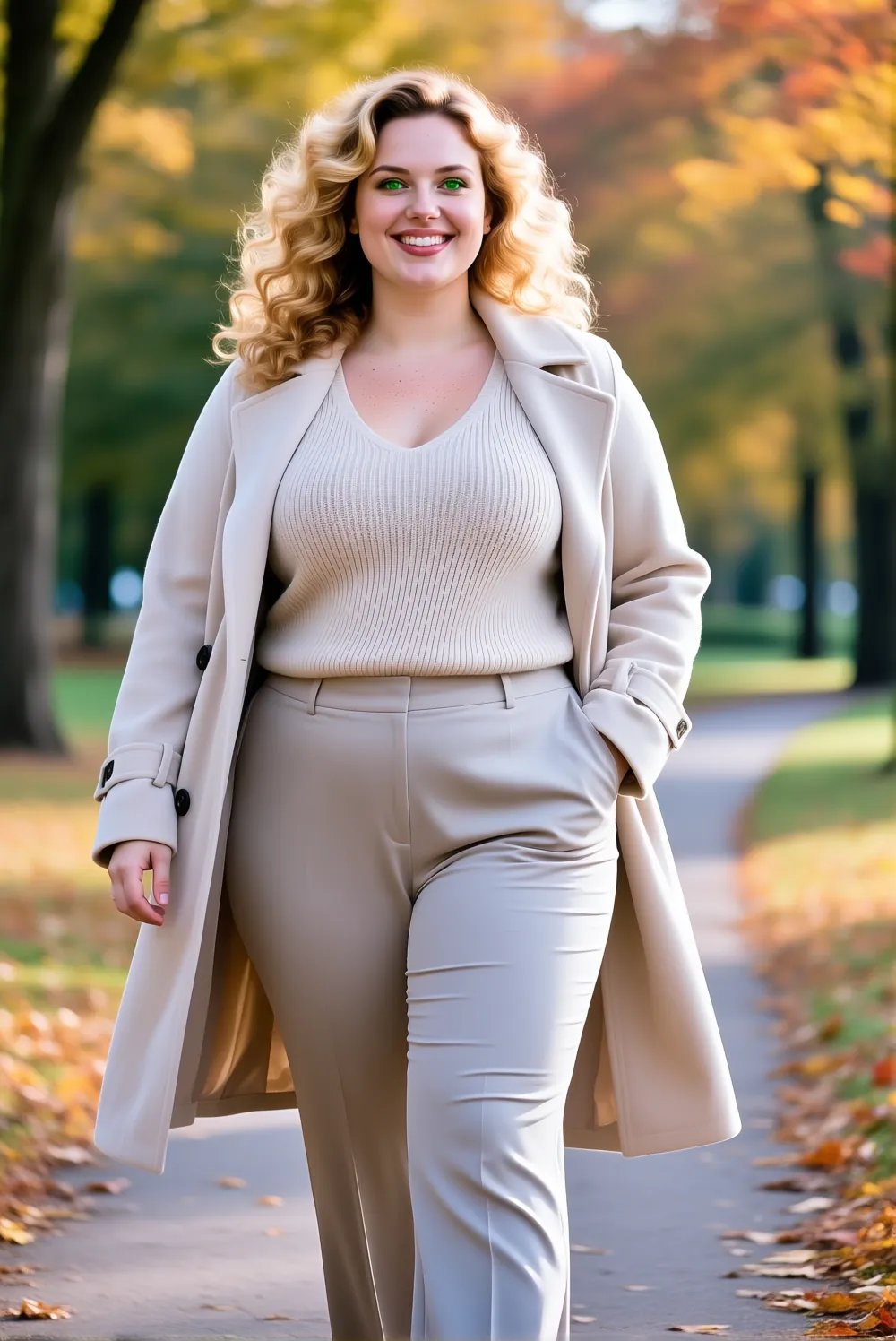
🍂 I've planned two hundred weddings. I've told two hundred brides exactly what to wear — what flatters, what photographs well, what survives a dance floor. Then my college roommate got engaged, and I had to dress for a wedding as a guest.
I cried in the fitting room.
I'm the person brides call at midnight. I know how to dress a hundred different bodies. But standing in front of that three-way mirror, holding a satin dress that hugged every inch I didn't want it to — I heard my own voice saying the thing I'd said to brides a thousand times: the dress is wrong, not your body. Except this time I couldn't figure out what "right" looked like for me.
That's when I called Nora. You met her here before — the friend who tore up her "when I'm thin" list and learned to style her real body. She's not a stylist, and she never pretended to be one. She just spent years figuring out the geometry of dressing a curvy body, and she's annoyingly good at explaining it.
First rule of wedding guest dressing: you are not a guest in your own body. You're a guest at a wedding — but you're the host of your own look. Brides get a team. Guests get a mirror. That's backwards, and it's fixable.
Why the fitting room mirror is a liar
Daisy's problem wasn't her size. It was the word every plus size shopper knows by heart: 「flattering」. In fashion, "flattering" is polite code for "smaller." So she reached for the dress that made her look smallest — tight, dark, shaped like armor. And it made her look exactly like what she was wearing: a person trying not to take up space.
Here's the shift. Flattering isn't about looking smaller. It's about looking put together — and that's geometry, not camouflage. Three rules, same as always:
1. High waist = longer legs
A high-waisted skirt or trouser sits at your narrowest point and moves the eye up. Legs read longer, torso reads balanced. This isn't a trend — it's proportion. It's why high-waist jeans win over low-rise in every decade.
2. Drape = skim, don't grip
Chiffon, crepe, soft knits — fabric that drapes follows your shape instead of clamping onto it. A tight dress announces every curve it passes; a draped one suggests them and moves on. Same body, completely different sentence.
3. Define the waist = finish the look
A waist tie, a belt, a seam that nips in — give your waistline a job. Without it, you're a soft column. With it, you're a shape. Nothing about your body changed; the geometry did.
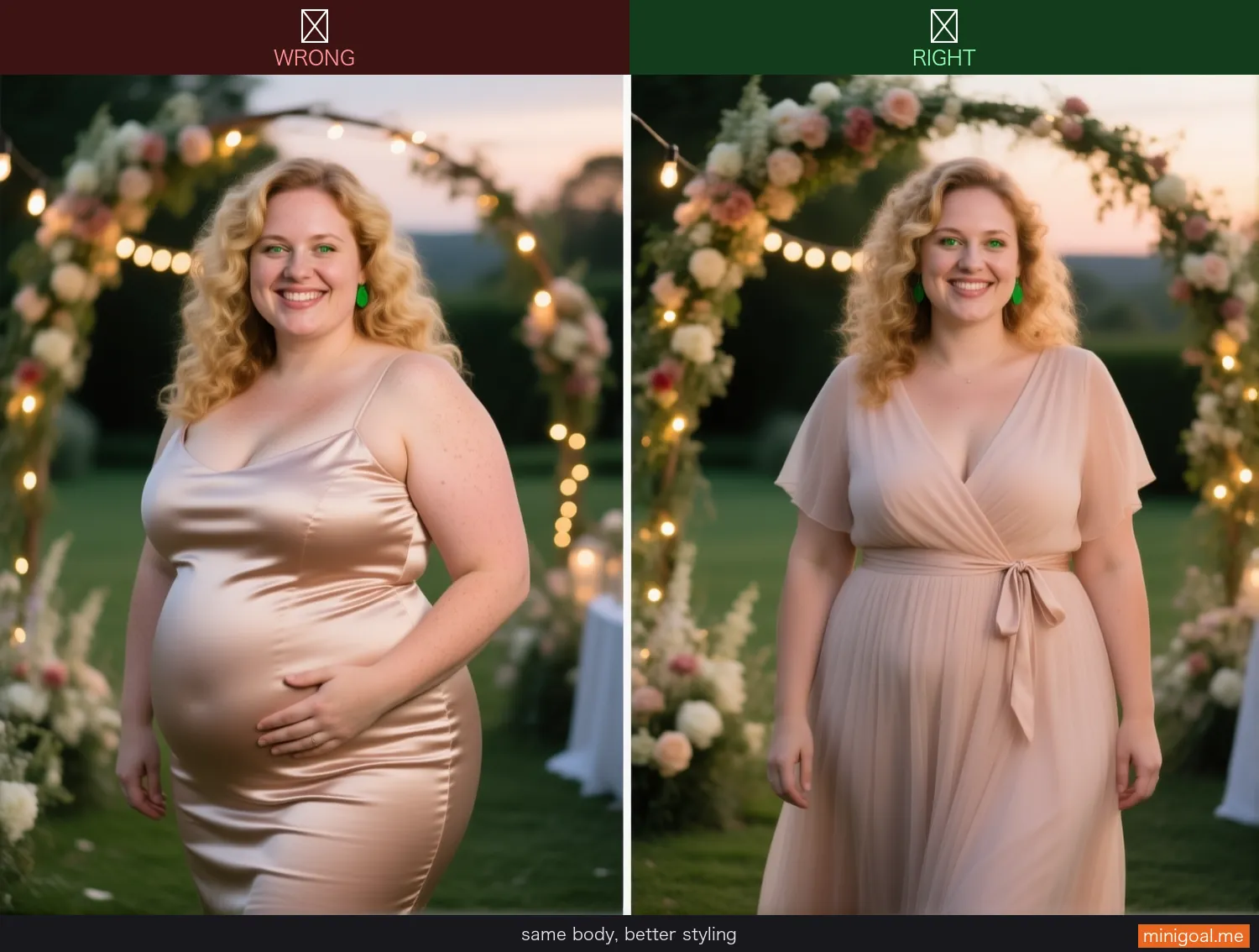
Look at the difference — and notice what didn't change. Same body. Same weight. Same face. The dress on the right isn't magic; it's math. The V-neck lengthens. The chiffon drapes instead of gripping. The waist tie finds the narrowest point and calls it home. You don't need a new body to dress for a wedding. You need three rules and a mirror that tells the truth.
What to wear to a wedding, guest edition
If you've got an invite coming up, here's the cheat sheet — three occasions, three looks, all flattering, none of them black tents.
- Formal evening wedding: a V-neck chiffon midi dress in a jewel tone — deep green, burgundy, navy. Add a waist tie or a slim belt. Heels or dressy flats, but let the dress do the talking.
- Garden formal (outdoor ceremony): a soft floral print in a draping fabric, or a high-waisted wide-leg trouser with a silk camisole tucked in. Prints read "I planned this," and the high waist reads "legs for days."
- Autumn wedding (cocktail-ish): a wrap dress — the original waist-definer — in rust, terracotta, or dusty rose. Long sleeves keep it seasonally right; the wrap keeps it flattering.
And the searches back this up. "Midi dress wedding guest" is one of the fastest-rising searches in this category — midi hits the knee or just below, which is why it flatters a curvy body. "With sleeves" is the fastest-rising modifier — if you've searched that, you're not alone, and the fix isn't hiding your arms, it's a sleeve that drapes instead of grips. And "black dress wedding guest"? It's the most-searched color — because everyone's scared of color. But the green dress, the burgundy, the blue, the floral? All safe. None of them upstage a bride. The bride is upstaged by a story, not a shade.
One more thing, and it's the one nobody says out loud: you don't have to wear a dress. A jumpsuit with a defined waist, a tailored suit with a soft blouse, a midi skirt and a silk top — if it fits the dress code and fits you, it's right. "Wedding guest" is an occasion, not a uniform.
The science bit (and it's not about fabric)
There's a real effect here, and it has a name: enclothed cognition — Adam & Galinsky, 2012, one of the most-cited studies in this area (DOI: 10.1016/j.jesp.2012.02.008). People who wore a white coat described as a doctor's coat performed better on attention tests than people wearing the same coat described as a painter's smock. Same coat, different story, different behavior.
Your clothes change how you show up. Daisy planned two hundred weddings dressed like a professional. She showed up to one as a guest dressed like she was apologizing. Same woman. Different outfit, different story. The dress that flatters is the one that lets you be the person who belongs in the room.
The bride isn't the only one who deserves to feel beautiful that day. A guest who looks polished isn't competing with the couple — she's honoring them. Showing up dressed like you belong is a gift to the people who invited you. And to yourself.
Before the next wedding, do this
Next time you have an invite — or just a Saturday and a mirror — try this. Pull three dresses or outfits from your closet. Put them on, one at a time, and ask the mirror: does this skim or grip? Where's my waistline? Does the length make me look stretched or stacked? Keep the one that skims, defines, and stands up straight. That's your guest uniform — not for hiding, for showing up.
You don't get to a wedding often. But you get to be the person who shows up looking like they're glad to be there. That's not vanity. That's respect — for the couple, and for the body that carried you there.
Loved this? The Outfit Tab in our app recommends looks based on your body type, the occasion, and the weather — no fitting-room tears required. → Try the Outfit Tab